
History of Psychology 2002, Vol. 5, No. 2, 204–206
Scientific psychology lost one of its strongest advocates and most creative practitioners when Paul T. Mountjoy died on May 22, 2001, in Kalamazoo, Michigan. Paul’s early research—from his dissertation in 1954 through the last of a dozen journal articles in 1968—centered on the classic Mueller–Lyer Illusion. His 1969 publication on falconry signaled a permanent shift to the study of the history of psychology.
Paul relied on patent searches and analysis of pre-20th-century manuscripts to uncover early, informal use of behavior technology. His interpretations of research findings grew out of Paul’s close and continuing relationship with Jacob Robert Kantor, who directed his graduate research at Indiana University. Kantor’s work in the historical evolution of scientific psychology focused on nonobservable cultural entities that continue to shape psychological theory and practice even through its most sophisticated experimental periods.
Paul’s choice of exotic—and sometimes erotic—topics attracted students and colleagues alike to the history of psychology. Among these are “The Duck Decoy: An Historical Analysis of Mobbing Behavior” and “Attempts to Modify Penile Erection in Horse and Human.” Paul published more than 20 historical articles, and he presented papers frequently at meetings of Cheiron, the International Society for the History of the Behavioral and Social Sciences; the American Psychological Association; and the Association for Behavior Analysis.
In the late 1970s, Paul began to vigorously promote Kantor’s interbehavioral psychology. In addition to many analytical papers and presentations, Paul authored Kantor’s obituary in the American Psychologist (with Jay D. Hansor; Mountjoy & Hansor, 1986) and biographical entries on Kantor in the American National Biography (Mountjoy, in press) and The Encyclopedia of Psychology (Mountjoy, 2000). At the time of his death, Paul and I were working on a biography of Kantor.
Paul himself believed that his legacy in the scientific culture rested on his editorial work on the Psychological Record and his participation in developing Western Michigan University’s (WMU’s) behavioral graduate program. Paul served as managing editor of the Record (founded by Kantor in 1937) from 1959 to 1976 and as an associate editor for more than 40 years. He joined WMU’s psychology faculty in 1964, served as department chair (1967–1971), and became Professor Emeritus in 1986. Among his PhD students are three interbehaviorists: Linda Parrott Hayes, Gerald L. Shook, and Douglas H. Ruben.
I first heard Paul speak in 1968, and we immediately became fast friends and fellow travelers. Paul guided me through the intricacies of Kantor’s writings and finalized my conversion to interbehaviorism.
Paul was a complex and gentle man. Free of racism and sexism, he was politically liberal, except for his support of the National Rifle Association. Without question, Paul was the best-read person I have ever known. He was an avid consumer of the arts, music, and literature, and used his extensive readings in these areas to inform selections and increase enjoyment of these pastimes.
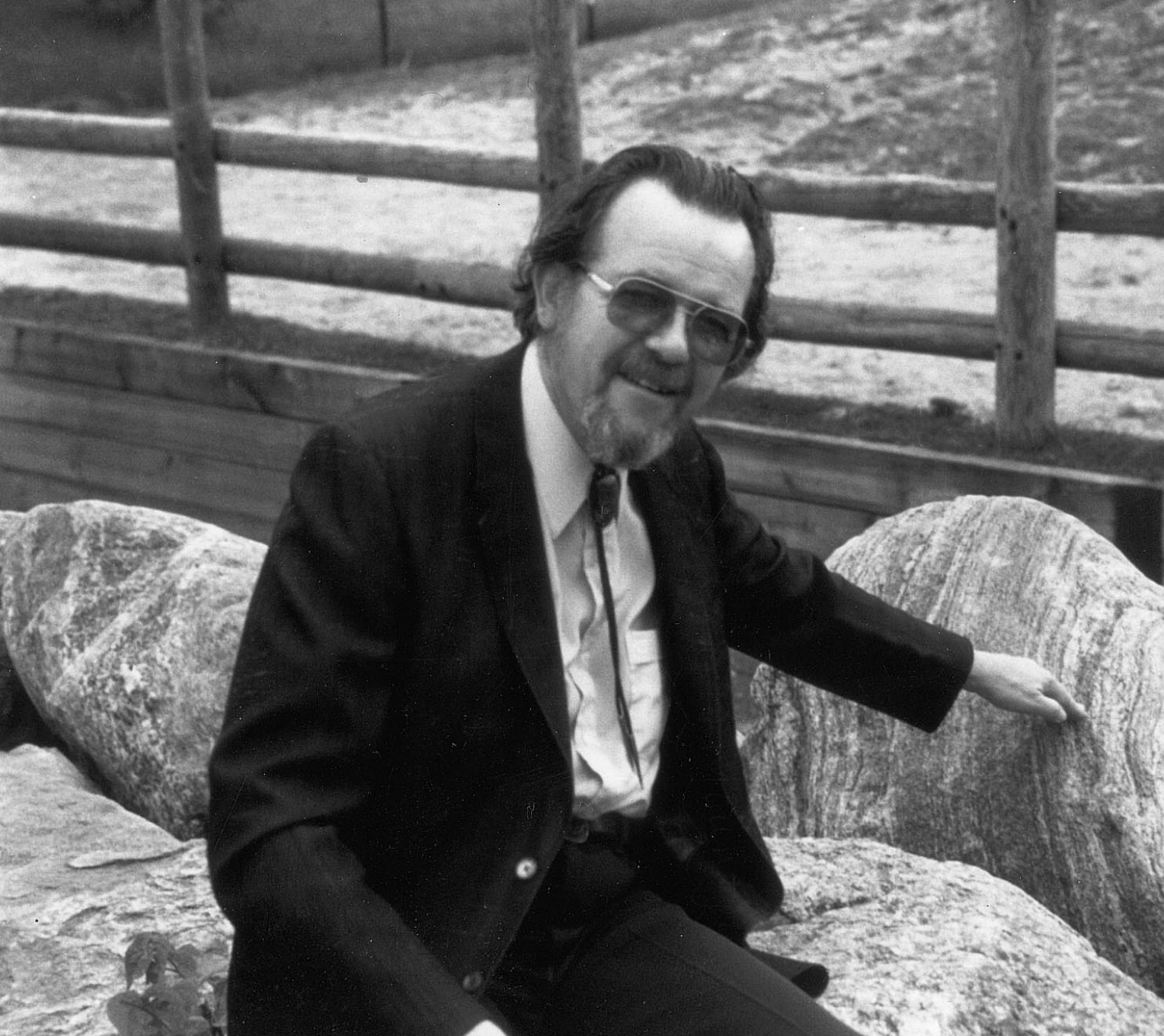
Paul T. Mountjoy (photo courtesy of Donna M. Cone)
Some aspects of Paul’s personality seemed inconsistent with his great intellect and retiring demeanor. His appearance was exotic and flamboyant. Over the years, he sported a variety of facial-hair styles, the Daliesque mustache being the most outrageous. Tall and lanky, he wore bollas and belt buckles with huge chunks of natural stones of the Southwest, many of which he had designed and made himself. Paul’s early life contains clues to his complexity.
Paul Tomb Mountjoy was born on October 25, 1924, in Des Moines, Iowa, the only child of a pharmacy student, Paul Sheldon Mountjoy, and a housewife, Fae Tomb Mountjoy. In 1925, the family moved to northeastern Chicago, where his father purchased a pharmacy in the culturally diverse, multilingual Ravenswood neighborhood. Even as a young child, Paul held strong philosophical beliefs: His best friend, Milton Wood, once carefully explained to Paul that there was no Santa Claus, and Paul carefully explained to Milton that there was no God.
Paul’s mother significantly influenced his intellectual development by taking him to museums, concerts, and plays every weekend and modeling reading as a pastime. Paul’s father, who played in small classical music ensembles and fished for relaxation, gave Paul his passion for these two pastimes.
In an unfinished autobiography, Paul wrote of high school as “an almost totally unmitigated disaster.” Reserve Officers Training Corps was the only class Paul T. Mountjoy (photo courtesy of Donna M. Cone) OBITUARIES 205 This document is copyrighted by the American Psychological Association or one of its allied publishers. This article is intended solely for the personal use of the individual user and is not to be disseminated broadly. that interested him and is probably the origin of his enduring love of marksmanship and hunting.
Swept along on the tide of patriotism created by the Pearl Harbor attack, Paul wanted to enlist at once, but he completed high school before joining the Army Air Corps in 1942. He became a tail gunner and flew 37 missions over Germany during 1943–1944 from a base in Laon, France. Having a male adolescent’s value system, Paul placed his helmet over his crotch during combat. He attained the rank of Sergeant before leaving the Army in 1945.
Paul entered college in 1946 on the GI bill and graduated magna cum laude from Lawrence University in Appleton, Wisconsin, in 1949 with a bachelor of science degree. He received a master of arts degree (1953) and a PhD (1957) in psychology from Indiana University. Paul was a member of Phi Beta Kappa and Sigma Xi. Paul first taught at two women’s colleges in Virginia (Randolph– Macon, 1954–1955, and Sweet Briar, 1955–1956). He then joined the Denison University faculty (1956–1964) and served as chair of psychology from 1961 to 1964 before permanently relocating to WMU.
Paul was a vocal supporter of the Archives of the History of American Psychology at the University of Akron. His papers are housed there and contain a treasure trove of insightful notes on topics that he researched but never published.
Paul’s life ended quietly of congestive heart failure minutes after he was stricken at home on May 22, 2001. He had survived heart bypass surgery for almost 20 years by following a scientifically based regimen and remaining compliant with prescribed medications. His ashes are interred at the Fort Custer National Cemetery in Augusta, Michigan, among the fields and woods he loved and a short drive from the Foundation for Behavioral Research where he served on the board of directors.
Paul is survived by his wife, Ingeborg Markus Mountjoy, whom he married in 1991. His two children, Charles and Carole Mountjoy, and his two granddaughters, Shaundra and Eugena, also survive, together with his former wife, Marjorie Passmore Mountjoy.
Donna M. Cone
New England Gerontology Academy
References
Mountjoy, P. T. (2000). Kantor, Jacob R. (1888–1984). In Encyclopedia of psychology (Vol. 4, pp. 432–434). Washington, DC: American Psychological Association and New York: Oxford University Press.
Mountjoy, P. T. (in press). KANTOR, Jacob Robert. In American National Biography. New York: Oxford University Press.
Mountjoy, P. T., & Hansor, J. D. (1986). Jacob Robert Kantor (1888–1984). American Psychologist, 41, 1296–1297.



 Listen on Spotify

You certainly captured the essence of Paul. He was unusual, brilliant, artistically appreciative, scientifically exacting, a good friend, and a wonderful mentor. I remember a trip to Chicago, where we visited the International Museum of Surgical Science and the Field Museum. In a then dark and dusty corner, two lions were in a small glass case, posed on a rock(nothing special). Paul told me it would be well worth my time to check out the exhibit. They were the famous man eater lions of Tsavo. He was right. He and I spoke very shortly before his death. I was headed to Michigan’s U.P. to do some geology–he was not doing well. It was our last talk. I regret I had too few years with him as a student and friend. Good job in your bio.
Thank you Ralph for sharing this story. Looks like Paul was indeed special!