

W. N. Schoenfeld
First published: March 1969, JEAB. Volume 12, Issue 2
Sometimes when the work of a man of scholarship and intellectual daring plunges ahead of the learned community he is addressing, it does not immediately receive the honor it deserves. Instead, as it blends unmarked into the scholarly landscape, it becomes somehow taken for granted. Something like this has happened to the writings of J. R. Kantor, and I should like, if I can, to reverse this course with respect to his Objective Psychology of Grammar and his Psychology and Logic. While these books are not necessarily the most important and enduring of his works, they reveal much of Kantor’s creative turn of mind, and expound well the scientific and philosophical viewpoints of this remarkable man-viewpoints by which theorists in psychology have already, though often unwittingly, been influenced, and from which they will be taking increasing instruction in the future.
Judging from the chronology of his writings, Kantor’s direct interest in language and logic took a little time to bloom after his doctoral dissertation-a long time, if measured against the present accelerating flood of scientific writing : 1935 for the Grammar, and 1945 (Vol. 1)-1950 (Vol. 2) for the Logic. (He paused between 1945 and 1950 to put out his Problems of Physiological Psychology, and several smaller works.) Neither work was widely read, at least not by psychologists-rarely have I found a colleague who owns these books, or who can more than vaguely remember hefting them in a library somewhere. The reasons for this cool reception and subsequent disregard are not difficult to muster. The few psychologists who were dabbling in language around 1935 were doing developmental studies for the most part, and it was not apparent to them that Kantor was saying anything helpful along that line. In the years spanning 1945-1950, most behavior theorists who thought of themselves as part-time logicians were involved in narrow debates on the merits of “hypothetic-deductive” versus “positivist inductive” conceptions of scientific method, and knew little of philosophy or of logic itself. In consequence, Kantor’s sheer venturesomeness in dealing with such broad matters as language, grammar, and logic, about which it was felt psychology “knew” so little, put some .people off. What he had “to say on all these topics seemed so contentious, so critical of well-known and eminent names, so unorthodox in flavor, that it all seemed better left alone by prudent minds. Also, his prose style is not easy reading.
But these reasons, even taken all together, do not seem to me sufficient to explain the neglect of these books. After all, their broad scholarship must have been evident to even the most casual examiner; their author clearly was au courant with the best and latest thought in the two fields; he was patently trying, and that eagerly, to get down to specifics and not just to declaim on a program. I think the final answer may be found in Kantor’s audience, and not in the man himself. It was our wit that was wanting, not his. We demanded too little of ourselves, and expected too much from him.
The contributions a scholar makes to the general fund of society’s knowledge can take various forms. In science, the accolade is usually bestowed on a man who offers his colleagues the means for extending his line of work, who describes or designs a set of practical tools or procedures, who suggests a method for concrete application. Such a man will, everything else aside, stand out in the scientific community, while one who leaves others to their own inventive resources will reap neither the fame nor the followers that are the rewards of science-in-the-market-place. Kantor’s position in psychology is to be seen in this light. He was a breaker of intellectual chains inherited from the past and a clearer of intellectual paths into the future; he could detect an incorrect direction, and point the one to take. He was a critic and an analyst; he could see what was to be avoided, and what to be done. He was a summoner to work and an architect of ideas; but, while he might hint at how something was to be done, he too infrequently went on to do it himself. Readers were cast back on their own resources. Even if they agreed with him, they needed to discover for themselves how to implement his thinking in research. Thus, Esper, who was a student of A. P. Weiss, and in the same philosophical tradition as Kantor, considers that Kantor’s efforts are only “programmatic”.
Of course, this was hardly likely to convert Kantor’s readers into enthusiastic followers. It is more encouraging to be shown, to be given an apparatus and experimental design, to be assured of solid achievement if such and such were done. Kantor offered little or nothing like this. He invented no devices, recorded few numbers, drew no graphs, used no statistics, programmed no computers, demonstrated no spectacular animal performances, beguiled with no anecdotes. All this he left to his readers. Kantor’s work generally had this aspect, but it was especially true of his Gram mar and his Logic because of their ambitious scope, and because they did try to speak to specific points. At the time of their writing, Kantor’s readers were not prepared to pick up where he left off and go ahead on their own. This is still difficult today. With our present research capabilities and intelligence, only a little can be done with any confidence. Should we for that reason continue to ignore what these books offer us?
But perhaps the darkness surrounding Kantor is beginning to lift, and we may soon be discovering that he has been a “great” scientist all along. The historical development of psychology has already paid him the compliment that some of his views are accepted today more widely than when he set them down, though it may not be known that he is their source. To my mind there is also grace in the fact that this delayed recognition may save Kantor from canonization as the founder of a “school”, a leader of disciples-the fate which has fallen to some past scientists who unlike Kantor provided guides for others to follow, or some ringing terms for them to adopt as a slogan. That is the way fashions and biases originate in science, just as they do in any field, since scientists are only men after all. For Kantor, who has valued only the highest intellectual standards, such a role would be offensive.
A retrospective appreciation at this time of these two books by Kantor may be useful, though it cannot cover their range of scholarship nor anticipate the verdict of future science. For present purposes, it must suffice to select a few of Kantor’s topics that illustrate his approach. Respecting those thoughts of my own which fringe this retrospect, at least some could well have been godfathered by Kantor.
II. AN OBJECTIVE PSYCHOLOGY OF GRAMMAR
The preface to the Grammar reveals the author’s spirit as well as his goals: “Grammar, at least in part, is psychological”. His predecessors, however, had concentrated instead on the physiology of speech, or on “psychologizing linguistic phenomena”. A genuine contribution by psychology to grammar “has had to wait upon the development of an objective psychology. As the following chapters will reveal, traditional psychology, which is subjectivistic, is impotent to handle language behavior.”
This censure of subjectivism is characteristic of all Kantor’s writings. It is an issue that has polarized the scientific community outside psychology (witness Schrödinger and Bridgman, who have announced for mentalism) and is still vigorously disputed by some psychologists, although many now agree with Kantor’s position. There are also psychologists who, while regarding themselves as behaviorists, have not thought through the ramifications of that view, and can be heard sounding like mentalists as often as not.
Kantor proposes two goals: “… analysis of the psychological character of speech considered from the angle of grammatical minutiae; and, the application of the results to grammatical problems.” These were extraordinary goals, unprecedented in their boldness. We have still not made much progress toward them. Fries’ Structure of English (1952) made its effort, but by 1957, when Skinner’s Verbal Behavior appeared, matters yet stood largely at the level of shrewd guessing, and only a small amount of data was on hand about the behavioral properties of speech or of language generally. On the other hand, Kantor was of the opinion that “psychological grammar is in no wise a competitor for the grammatical field. In many ways it is a distinct discipline with problems different from those of ordinary grammar. At best, psychological grammar is only one type among several others, each concerned with different phases of language. Certainly, psychological grammar can deal most efficiently with the grammar of speech, and less well, if at all, with the historical or comparative facts of language.” This willingness to acknowledge the complexity of verbal behavior occurs throughout the book. Indeed, he believes any theory of language acquires some “fundamental merit” (p. 225) simply by allowing for such complexity. As for the book’s mission, Kantor intends “particularly that whenever conventional grammar is criticized it is only in order to pave the way for constructive suggestions and not to indicate mere dissatisfaction”. It was in this, of course, that Kantor was misunderstood. His readers did not see his suggestions as constructive they did not see what to do with them-and so the book fell into obscurity.
The Grammar is divided into three parts. Part I is historical-critical-methodological. It is vintage Kantor for anyone familiar with the tenor of the man’s lifetime work; but, in 1935, it must have seemed a bit wild. He digs in at once along two veins. First, subjective or mentalistic or psychic theories of language (speech) must be abandoned in favor of a functional analysis of the behavior as part of the organism’s interaction with, and adjustment to, its environment. Words (and gestures) are “actions . . . performances . . . not things or instruments”; the classic “definition or interpretation of speech as instrumental has resulted in masking the adjustmental character of speech behavior” (p. 15). In that interaction with the environment, three variables need to be recognized as the sources of controlling stimuli (pp.14-15) : the thing spoken of, the person spoken to, and the behavior of the speaker (compare Skinner’s later “tact”, “mand”, “audience variable”, and “autoclitic”). “Grammar as the science of speech must be an autonomous science . . . [with its] own unique subject matter. This subject-matter is not things, but the speech adjustments of individuals . . .” (p. 15). Second, the old affiliation of grammar with logic must be revered. “Since Aristotle, at least, language has been regarded as somehow connected with thinking. Every grammarian wants to be a logician; he regards himself as an expert upon how to think clearly or at least to express thought lucidly. In the meantime, grammar has become something other than adjustmental behavior. . . . This subjectivity led to the notion that speech had . . . to do with thought. . . . Words were considered the carriers of meanings . . . grammar became the discipline for ordering thoughts” (p. 8). Only by following the new paths of behavior analysis, Kantor urges, will grammar and linguistics be able to break the death-grip in which they have been held fast for so long by an “occult psychology” (p. 16).
Part I then expands some topics that Kantor regards as background: classifications and definitions of language forms, historical connections between linguistics and psychology, arguments from several quarters against the psychological analysis of language, psychological misconceptions in linguistics, speech as behavior, the patterning of speech into grammar. Controversial or not, there is no college course in language which could not profitably assign these chapters as a reading for students.
Part II considers “general grammatical problems”, dividing them into the recognized branches of phonology, morphology, syntax, and semantics. Kantor criticizes this division, but is willing to adopt it for expository purposes. Aristotle’s theories of behavior are defended as objective (Kantor is the Aristotelian among modern psychologists), whereas psychophysical dualism is said to have emerged dominant from Hellenistic times, particularly after the Alexandrian conquests which brought together Greek and Oriental traditions. This dualism is traced through the middle Ages in Europe, through St. Augustine and Descartes and Weber and Fechner and Wundt. Kantor detects it in each of the four branches of grammar, and puts his reader on guard against it. The four branches are then taken up in the order followed below. Kantor’s plan is “to point out in each chapter the present grammatical status of the problem under consideration. Then we propose an objective psychological interpretation. By following this plan we hope to contrast the conventional grammarian’s emphasis of classification, definition, and redefinition of supposedly fixed forms with the psychological conception of multiplexly determined concrete linguistic or reference adaptations” (p. 112).
“Semantics” is given a brief treatment, undoubtedly because much of the agitation in this field came after 1935. Ogden and Richards had published their Meaning of Meaning in 1927, but Kantor apparently did not feel it necessary to deal extensively with it in his Grammar since he had already spoken out on such approaches as early as 1921. In the Grammar, therefore, he was content to point out simply (p. 36 ff.) what he regarded as the fundamental error of Ogden and Richards; that is, that they are “symbolists” who “reify” words and give them “symbolic and emotive function”. As I have written elsewhere, it seems to me that, from the behavioral view point, the “meaning” of a word is exhaustively given by two specifications: the conditions under which the speaker utters it, and the response it produces in the hearer. I think this is the same sense in which Kantor (and Skinner, too) would understand “meaning”, and for that reason he can deal with “semantic change . . . as changes in vocabulary style” (p. 125). Because he could dispose of the topic in this way, Kantor’s chapter on semantics could be brief.
“Syntax” must be freed from the shackles of logic, and freed also from its traditional character of static linguistic categories. It must deal rather with the “dynamic unfolding of verbal play”, and not, as present grammatical syntax does, with “the construction of puzzle pictures (sentences) out of its component parts-a process involving . . . dead materials” (pp. 128-9). Kantor’s wide-ranging discussion encompasses such problems as syntactic units, the psychological or behaviorally functional sentence, sentences as speech patterning, sentences versus propositions, subject and object, the syntax of the hearer, the copula, the verb, ellipsis. Quarrels over whether or not he is correct at any point are not of much use. The fact is that although his discussions are wealthy in provocations, Kantor does not offer any research data on these problems, or suggest appropriate study methods wherewith his readers might strike out on their own. Here, where he is making statements of an increasingly empirical character, is where new methods of research would have produced advances in real knowledge and would have won Kantor disciples. But none is ventured. It is enough to make a reader feel dull-witted when he cannot devise such methods himself; such a feeling leads to defensiveness, and defensive readers are unlikely to be admirers. If failure is to be apportioned in such a situation, it is as much ours as Kantor’s.
“Morphology” is an examination of “Words”: their definitions, lexicons, derivations, and subunits. Kantor examines such problems as : the syllable as an abstraction, the creation of linguistic artificialities by morphological analysis, the emergence of speech “style”, the comparison of languages, linguistic evolution, and, finally, how words are derived (including their behavioral function). Again the chapter is short and provocative, with no practical guides to research.
“Phonology” feels the blast of Kantorian anger against the analysis of behavior into static categories (“grammarians . . . murder a living action in order to dissect out of it fixed sounds”-p. 159), against the phoneme (de Saussure’s term) as a psychic phenomenon, against the “abstracted sound” as symbol (Sapir, and his predecessors and followers, receive their lumps). It is in this chapter that the philological problem is raised of linguistic mutation of the type exemplified by Grimm’s Law. Kantor points out that since Grimm used literary materials his so-called law really dealt with letter mutations rather than phonetic changes. Credit is given to earlier writers who saw “the need to study actually produced sounds instead of letters” (p. 175), but the work of Grassmann and Verner, while seen as a movement in the right direction, is criticized as not focusing on the proper sound units. When I was a graduate student and had occasion to reflect on these matters, I was led to suppose that spoken languages are most susceptible to historical phonetic changes (a) where the sounds are given varying pronunciations, forcing hearers to be discriminatively most tolerant; (b) where the sounds are difficult to produce, so that speakers tend to “drift” in their production of those sounds; and, (c) where hearers do not discriminate between certain sounds as well as others, so that, when the hearer takes his turn as speaker, he will be more deviant in approximating those sounds to some standard. Kantor recognized (p. 160) such variability in sound production. My thought was to couple linguistic changes with actual behavioral factors, as opposed to historical or literary processes. Variability in sound production and reception seemed to provide a plausible avenue of inquiry then, and it still seems to me to have some promise.
Kantor closes his chapter on phonology with a nod to the new techniques of sound recording, oscillography, and such, which at the time of his writing were just making their presence felt in language study. He saw their possibilities, but worried about their possible misuse in the service of false phonologies. It is at this point that the word “interbehavior”, which was later to figure so large in Kantor’s armamentarium, makes an inconspicuous appearance (it is not listed in the book’s index) : “. . . objective psychology . . . looks upon not only the intrinsic organization of speech, but also its origins and operation, as concrete phenomena of linguistic interbehavior” (p. 178).
Part III of the book gets down to “particular grammatical problems”, the psychological analysis of the “grammatical minutiae” promised in the Preface. With a daring unknown to any predecessor in psychology, Kantor comes face to face with topics such as: parts of speech, person, gender, case, tense, number, voice, mood, direct and indirect speech, and negation. His persistent concerns are to free functional speech’s “grammar” from logical categories, and to hold fast to a non-mentalistic analysis. His discussion becomes technical at times, but it can also stick to common sense. Thus, in speaking of anomalies of person, he sees as “peculiar” the statement of F. Boas that “a true first person plural is impossible because there can never be more than one self”. (I thought of how Kantor might have expressed himself on a problem such as the “impossibility” of the double possessive, as in the phrase “a friend of mine” [see A. G. Hatcher, Word, 1950, 6, l-25].) Turning to tense, he declares “we must face the facts of tense without time and time without tense” (p. 242), and concludes that “no matter what (the speaker) says from the standpoint of conventional words or gestures, if he refers to some temporal aspect of an adjustment stimulus, we may and sometimes must describe his behavior as tense” (p. 248). With respect to direct and indirect speech, Kantor affirms the existence of “answering reactions” and speech referring speech” (p. 297), a type which Skinner later termed “autoclitic”. The knotty problem of negation brings back in full force for Kantor the dilemmas generated by tying grammar to logic, and very near the end of the book there is an intimation of a question that will come up again in Psychology and Logic; namely, the possibility of a logic, and of a calculus of logic, built upon a different set of rules than those classically employed, since those rules need not be taken as absolute. In this category, while treating “negation as a psychological phenomenon” Kantor would put the law of excluded middle, including its application to the copula “be” itself: “In the field of speech, even more than in others, we must take account of the fact that aside from the withdrawal from absolutes there are all sorts of possibilities in utterance to be allowed for. We may therefore refer to a series of degrees in the non-existence of things spoken of. It is not a question always of yes or no, but how much, since speakers may refer to all sorts of contingencies” (p. 309).
In retrospect, the Grammar is a stunning book-in what it tried to do, in what it did do, in what it foreshadowed, and in what it failed to do. It was re-issued unchanged in 1952-was there more for Kantor to say of systematic value? One would suppose not, although the author in his brief preface to the new printing regretted that “the pressure of other work” had not afforded him “a favorable opportunity” to include research in the field done in the intervening years. In any case, the Grammar is an historic book: what one man dared to try, others after him were sure to try again and inevitably with more success. But while the book will grow in historical importance, and in the manner of such books will become a source of quotations, it is to be hoped that the spirit of its author will not be lost in the process. After all, its sentences are a fossil record ( cf p. 29) in print of only some of his verbal behavior, and, even when honored, should be remembered as only “abstracted details of what [was for him] always a very complicated event” (p. 165).
III. PSYCHOLOGY AND LOGIC
The Preface to Psycho logy and Logic opens with the declaration: “Two basic theses underlie the present work. The first, the specificity theorem, signifies that logic is essentially concerned with specific events and not with universal and transcendent systems. The second, the interbehavioral theorem, implies that no matter how logic is defined it entails a psychological dimension which must be taken into account.” In expounding these, Kantor notes that “though writers on logic differ in their views concerning the nature of logic . . . they all agree that they are seeking the one true and valid system. Rarely is it suggested that no such universal system is available.” Rather, “there are many logics”, and we must recognize “that the referents for the term logic are always individual human enterprises located in particular fields or frames of reference”. Logicians err in that, “although logic is obviously a human enterprise (they) inevitably regard it as ultimate, universal, and transcendent”. This happens because, “behind the unsatisfactory assumptions that logic is infallible, comprehensive, and transcendent unquestionably lies unsound psychological theory”.
From the outset then, the book promises to be an exciting one, and it is. The flavor is even more strongly Kantorian than that of the Grammar, and more didactic and polemic. The vastness of the undertaking, as well as Kantor’s intellectual daring, are seen partly in the range of things named in the chapter titles and sub-divisions. The author’s acquaintance with the literature of the area is clear from the bibliography, and his grasp of it from the textual uses he puts it to. Interestingly, the term “interbehavior” has now come to the forefront of Kantor’s psychological vocabulary. It will serve henceforth as both noun and adjective, and on occasion even as adverb, since in Kantor’s hands (as they were in Woodworth’s) all psychological nouns are really act ion words. In all of its uses, how ever, the term carries the single Kantorian theme that the behavior of an organism is in continuous interaction (through feedback loops, as contemporary fashionable terminology might have it) with the products of its own behavior and with the environment; as a consequence static concepts of “stimulus” and
“response” are as unsatisfactory starting points for behavior theory as are absolutistic concepts of logic for logical theory. This is reminiscent of his statement in the Grammar (p. 164) that “. . . analysis (of speech) must not transform living and ever-changing linguistic responses into fixed structures built up from static materials”. “Interbehavior” has by 1945 become Kantor’s most general term, both descriptive and theoretical. It is not, however, an easy one for the reader to come to grips with, so the term did not catch on and did nothing to promote Kantor’s popular image. Re-stated, the notion is basically that of the “behavior stream” which is a continuous function without gaps or “holes” in it. This continuity doctrine-which for Kantor made useless any behavioral formulation employing static S and R terms-was certainly not new, and was widely favored in one form or another, but it was not recognized that Kantor was basing his proposed behavior analysis on that idea. This same approach to the description and systematization of behavior may soon be receiving new attention, with some workers trying to deal with the stream experimentally.
The Preface anticipates, and the text fully displays, Kantor’s foundation approach to his subject. It is typically Aristotelian, utilizing a historico-critical summary and analysis as its starting point. This method is always enlightening, often profoundly so. In psychology, where it is often most needed, Kantor is one of its most skillful exploiters (and has given us a fine example of its use in the first volume of his recent History of Psychology), but it is equally profitable in diverse fields in the hands of such skilled practitioners as E. Mach and V. I. Lenin. But the vibrant methods of the Logic, like those of the Grammar, have not made their proper impression on either psychologists or logicians or philosophers of science. As with the Grammar, this book does not offer concrete suggestions or follow-up methods to lead the reader on to research work of his own. He is left once again with a “where do-I-go-from-here” feeling. Again the upshot has been that Kantor’s thinking is judged to be non-productive, when it is rather our own which has been unresourceful.
The exposition of “specificity logic” begins with an explicit statement of eight postulates. I should add at once, however, that “postulate” here has a different sense from the one usually understood by psychologists who take Hull as their example of deductive or constructional system builders. That Kantor’s sense is different should not, of course, be surprising to readers who recall his view of the interbehavioral nature of verbal propositions. Thus, he says at the opening of Chapter I: “Of recent methodological and expository developments in logic and science nothing surpasses in merit the increasing practice of setting up postulate systems.” But the fact that his meaning of “postulate” is other than the usual one is plain throughout the book where logical and scientific “constructions” (read inventions, fictions, or purely formal elaborations) are rejected as not profitable.
The eight postulates are: (I) Logic is operational; (2) Logical theory is continuous with practice; (3) Logical operations constitute interbehavioral fields; (4) Logical interbehavior constitutes system building; (5) Logical interbehavior is specific; (6) Logic is uniquely related to culture; (7) Logic is inseverably interrelated with psychology; (8) Logic is distinct from language. From these eight propositions, the rest of the book is believed to flow. They are summarized in a thematic statement with which Chapter I closes: “Logic is neither science nor the theory of inquiry or investigation.” This is an amusingly instructive counter view to that of such classic deductively minded logicians (or as Kantor might say, non-interbehavioral, absolutistic logicians) as Cohen and Nagel who had earlier (1934) emerged from their attack on J. S. Mill’s canons of experimental inquiry with the conclusion that “the experimental methods (of Mill) are neither methods of proof nor methods of discovery”. Kantor goes on: “The notion that logic discovers and applies rules for scientific work is objectionable on at least two grounds. First, such a view is based upon the idea that system and order, in other words, abstractions and rules, are more important than the materials and actual investigations. Actually contacts with events may require new and as yet completely unknown techniques. Secondly, the particular processes of investigation with their errors and missteps are minimized. This view is also fatally reminiscent of formalistic and deductive ideas of science. There is a science of logic as well as a logic of science” (p. 19). Since contemporary beliefs among behavior theorists is that scientific method generally involve the very deductive-absolutistic ideas about logic and the calculus of propositions that Kantor rejects, his position has here also not been one which might have added to his popularity over the last several decades.
It is, of course, not possible to comment here on all the problems and topics that Kantor treats in the two volumes of Psychology and Logic following his statement of his postulates. What is feasible is to select a few matters which are perhaps of more immediate interest to psychologists today, as well as of some personal interest to me.
Logic and Language
As was said repeatedly in the Grammar, language and logic are closely tied together, but not because the study of language means the study of logical propositions or logical categories, and not because logic determines grammatical units or categories. Rather, logic is a set of propositions couched in a constructional language system (cf. Grammar, p. 319). Since language and grammar are inter behavioral, logic in turn becomes behavioral in two senses. First, to understand either classical or modern logical systems as the end products of reacting human organisms, the language behavior, training, and context established in the logician by his social environment must be known, since he necessarily draws upon those for his thought, his propositions, and his system. Kantor believes that even Aristotle saw this and commented upon it. Second, the interaction between the practitioner of science (or of logic, or of any verbal play) and his environment is determined by the actual conditions under which he is operating and by the data he is in process of obtaining; since this interaction or interplay is the “logic” we wish to understand, we can do so only by understanding the interactional behavior itself.
What a language can say, as distinct from what can be done with what it says, can confuse the preoccupations of a logician who fails to keep the sentence itself separate from its alleged referent. Thus, English can take any sentence and insert a negative somewhere in it (or re-state it in negative form), but doing this does not, of course, create an existential or even meaningful referent for the new sentence how many conundrums about non-existing things or non-things have devoured how many Russellian philosopher-man-hours in their imaginary solutions! Again, Indo European languages, and the several systems of mathematics which can be based on them, permit repetitive statements to be made; this allows for repetitive operations, such as division, but also, where the actual referent is lost sight of and a different referent is invoked, permits us to be seized by Zeno-esque paradoxes, and by .uncertainties as to what is “meant” and how something “can be”. Or, again (if I may echo C. D. Broad), the copulas in classical syllogistic premises are indefinite about the temporal duration of properties in the predicates assigned to subjects, as if, when we apply the syllogisms to things in the real world, we can ignore time, abstracting the “existence” of a thing without considering time as a critical aspect of existence. Our language also permits us in several ways (e.g., by gerundive, or by substituting the article “the” for the “to” of infinitives) to make verbs (actions) into nouns. This creates many traps for scientific thinking in our culture (more, it would seem than making nouns into verbs!). As A. J. Ayer has remarked in another connection, “The mere existence of the noun (he was talking about “god”) is enough to foster the illusion that there is a real . . . entity corresponding to it”. If these and other linguistic restrictions and liberties were different, how different might our thinking and our logic be. And, if no single representative system of formalized language structures is “correct”, if logical systems can be changed simply by altering the initial axioms and formal rules of language, then no scientist need apologize for his genuine interactions with the outside real world, no matter what protest may be raised by the partisans of special logics. For the scientist, logic must accommodate to science, and not science to logic, just as theory must give ground to fact, and not fact to theory. Kantor was surely right in emphasizing this (his examples were different from mine), though it is a difficult point to express and can, if one lowers one’s guard, reduce to metaphysical quibblings.
Deduction and Induction
Psychologists have here inherited, and carelessly entered into, an issue of classical standing that has broadened in recent times into an issue regarding scientific method. As a purely formal logical question, deductive procedures and inductive procedures have been set against each other with respect to validity of inference. Each is said to have its characteristic weakness, though that of induction is the more widely recognized today because the fashionableness of deduction has caused its difficulty to be blinked. Both before and since its Baconian resurgence, induction has been regarded as flawed by the necessity of “leaping” from particular to universal propositions. For its part, deduction is said to be flawed by its “petitio principii” character. If each of these flaws is fatal, a submissive scientist might truly be in a quandary over whether to continue his research or wait for the logicians to find an anodyne for their headache. Our university courses in behavior theory usually present the deduction versus induction issue in the inescapable lecture on the nature of “scientific method” and of “scientific theory”. That nature is a matter of inquiry, not of dogma. Contemporary fashion favors the “hypothethico-deductive” or “constructional” dogma of method and theory, but such fashions in science are substitutes for facts, and flourish where facts are few. This was not always the prevailing view (we might recall here Duhem’s discussion of styles of theory), nor do I believe that in any concrete scientific research situation the dogmatic distinction between the two is defensible.
In any case, debates and polemics about “scientific method” and “scientific theory”, both in psychological literature and the classroom, fail to distinguish between what the writer or speaker thinks scientific method is, or what he thinks it should be, between what scientific theory is, or what it should be. In brief, what is the scientist doing, and what is it thought that he should be doing? The former is an empirical question, and it will take facts to settle it. But, indeed, there is very little hard information on the matter. The usual descriptions, and the oft-used historical examples, are to my mind ill-drawn reconstructions of what actually happens in the scientist’s behavior when he is “making science”. They represent only fashionable misconceptions projected onto presumed but defenseless exemplars (the use of dead scientists as behavior material recalls Kantor’s lament, in the Grammar, p. 17, over the use of “lifeless forms” of language that are studied in grammatical treatises). The second question-what scientific method or theory should be-could have an indefinitely large number of answers (not one of them moral) depending upon whether the purpose of the method or the theory is aesthetic, practical, didactic, systematic, exploratory, parsimonious, or whatever. Moreover, to judge how efficiently a given method or theory meets the criterion of what it should be, would require some means of measuring or evaluating or estimating that efficiency. This is a far cry from how the matter is usually portrayed in the debates and classroom lectures of psychologists.
Current emphasis upon deductive elaborations in psychology proceeds from the comforting, but I think mistaken, belief that the physical sciences owe their modern pragmatic successes to their constructional theoretical systems. Our students are taught that a theory begins with postulates or axioms that are unchallengeable; that these propositions contain terms that need no definition; that deductions (often claimed to be reducible to the classical syllogistic moods) are made within the self-contained system of propositions; that these deductions are then tested in the laboratory or field; and finally that if the empirical findings make it necessary, the propositions anterior to the empirical test are altered to conform with, and to generate, the new finding, but that otherwise congruent empirical findings may be declared to be “consistent with”, though not to “prove”, the system as it stands thus far. This sequence of practice is said to be beyond the power and legitimate scope of inductive procedures or inquiry. The latter are said to be simply incapable of rationalizing the practice because they force an inductive leap from particulars to universals. What is not often pointed out is the companion difficulty of deductive practice when it is described this way, namely, to say where the axioms or postulates come from in the first place. To reject this question as irrelevant or ad hominem, and to argue that only the ultimate correctness of the postulates is of interest, is to deny that human behavior is involved. It puts the origin of postulates into the sphere of disembodied whimsicality and mentalism, and thereby makes it impossible to instruct anyone in how to go about the business of science. This may perhaps satisfy some logicians, but it will not satisfy the true scientist, nor does it Kantor. Those same logicians, moreover, would not abide matching the same argument for the defense of induction; that is, that the invalidity alleged of the leap is irrelevant, and the allegation ad hominem, and that only the final correctness of the leap is important.
In truth, of course, the supposed opposition of deduction and induction cannot be found in the actual living work of scientists. They not only reduce to a single process in practice, but can be so reduced in verbal description as well. I mean more by this than that, as some logicians and philosophers have held, there is no difference between induction and deduction because the former is reducible to the latter. What I mean is that the latter is also reducible to the former if one wishes to proceed in that direction. In short, the mutual reducibility means identity ab initio and strictu sensu. Starting from particulars, the inductive universal proposition can be formed without any delay regarding “validity”, either as a mechanical linguistic exercise, or because the human scientist, like other animals we are acquainted with, is subject to some gradients of generalization. This universal, once formed, is in no way different functionally from an assumption or axiom or postulate which is also stated in universal form. Once formed, the inductive universal may be “tested” to see whether it is applicable to any desired situation or variable; if the test is failed, an appropriate qualification may be attached to modify the range of the universal proposition, or to reduce the breadth of the class (in the manner of Newton’s Rule IV); but the residual proposition remains in universal form, and does so no matter how many qualifications may be indexed to it. For what is not as yet on the list of exceptions, the proposition is treated as universally applicable.
It is, in point of fact, because the inductive generalization is universal in linguistic form, just as the postulate is, that “tests” of it are possible. It is not the form of the proposition that is at issue, but how the proposition has been arrived at. The inductive generalization openly declares itself to be based on previously ascertained facts, even if particular ones. But where does the postulate come from? It is plain silly to imagine any rational scientist actually doing what some have claimed he does or should do, or what he is praised for doing as a “deductivist-constructionist”; that is, close his eyes and reach into a grab bag of possible postulates, come up with whatever ones he chances upon, explore their logical consequences, put those consequences to experimental test, and then, if necessary, revise those postulates or go back to the grab bag for others. Such a view of scientific method anyone can have who wishes it, but both Kantor and I would beg to be excused. That position, literally interpreted, not only removes the choice of postulates from connection with established knowledge, but it gives the fool equal rights with the scientist in the choice; it means that we yield any hope of acquiring new knowledge, since the chances of pulling a “good” postulate are vanishingly small because the contents of the grab bag are infinite in number; it means that even “good” postulates, being sentences of finite length, are doomed to be wrong when endlessly tested against an infinite world; it means that our purpose becomes one of proving propositions right or wrong, rather than of learning something about the world; and so on. Into blind alleys of this sort are we led by a defense of the disembodied origin of the postulate. This remoteness of origins and sources, their divorce from actual human behavior, is intended to give postulates unassailable rational status. But the intention does not square with reason, nor will it succeed in practice. It has been said that such views of a postulate only result in reducing it to the level of a “guess” (we ought to recall here Russell’s amusingly contrapuntal charge that inductions are merely plausible guesses from which deduction can proceed!), and that nothing is gained by changing the name of guess to “assumption”, “axiom”, “prediction”, or “postulate”. Not to be dismissed in this way are the questions of who is guessing h ow at what and why. In such a guessing game, we are as individual scientists naturally concerned with who is the better “guesser”, for he is the better scientist from whom we wish to learn. We may be confident that he will have more than chance guessing to teach us.
If, then, a “postulate” emerges from present knowledge, just as an inductive generalization does, and if scientific inquiry is viewed as trying to base itself on present knowledge and to add new knowledge to old, then the alleged opposition between deductive and inductive methods in science disappears. Postulates in a deductive system and inductive universals are generated in the same way and operate in the same way in the scientific behavior of scientists. Kantor’s own treatment of the induction-deduction issue involves, typically, a rejection of all attempts at solutions based on logical absolutes. He makes the problem one of specific behavioral conditions and outcomes instead of dispelling the alleged logical incongruity between the two. “No ambiguity attaches to universals in interbehavioral logic. Universals are products of system building operations, but they are something more than end points in the operational procedure; in addition they constitute the raw materials of further system-building operations. This characteristic, it should be noted, universals share with relations, classes, kinds or species, mathematical functions, and other constructional forms” (Vol. 2, p. 131). “It is encouraging that (some) philosophers . . . suggest abandoning the inductive problem. But something more than logical policy is called for. We must take into account the specific system-building enterprise. Whether or not the procedure is inductive or deductive depends upon the kind of materials used” (Vol. 2, p. 332).
Cause and Effect
Kantor’s discussion of causality should be an attention-catcher for psychologists whose science is still half-immersed in pre-naturalistic thinking wherein spontaneity and voluntarism continue to be treated as behavior sources. Language forms and traditions of usage are among the reasons for the slowness with which such “causes” are perpetuated and not recognized for what they are: “. . . commerce with mythical subject matter (which) is possible by means of linguistic factors. It is possible to construct real existence, systemic existence, possibilities, and determiners of all sorts without adequately analyzing acts and stimulus objects” (Vol. 2, p. 165). Moreover: “Everyone who approaches causality from the angle of events must be impressed by the variety of causal situations. . . . Conventional doctrine projects the general presupposition that causality constitutes a basic law of nature or of science. The assumption is made . . . that the universe is constructed on a plan of necessary connection. . . . Once more we see exhibited the enormous hold of abstractionism and generality on logical thought, as well as on the analysis of science. The result for causal study is such a vaporization of events as to allow anything to be said about them. In such a vacuous causal universe it may be asserted that ‘Whatever is, may not be’, ‘Not everything that could happen does happen’, ‘The contrary of every matter of fact is still possible’. The universalistic claim that the world is a system of necessary connections namely, ‘every effect must have a cause’-is not condemned by us merely because it is a vain apothegm. Not at all. The gravamen lies in assuming that such an assertion is factually significant” (Vol. 2, p. 152).
Kantor’s discussion of causality is wide ranging, beginning with a survey of the historical roots of the idea and coming up to modern writers. A psychologist interested in the conceptual problem of causality (including Piaget’s developmental approach to how this concept is met in the thinking of a child in Western culture), will find a good many places where his own reflections might pause. Some examples of where I did:
(a) The familiar Hobbesian view of motion, “There can be no cause of motion, except in a body contiguous and moved” (Vol. 2, p. 151), raises the problem of action-at-a-distance. In the history of the science of mechanics can be traced the classic conflict between scientists, and between theories of motion, taking op posed views as to whether action-at-a-distance is possible or not, and whether it is a proper basis for theory. Those physicists who accept the idea that a satisfactory causal theory of motion can tolerate distance without contiguity of bodies believe, in Kantor’s words, that “causal events as data consist of particular interrelationships of observed happenings” (the reader may recall Skinner’s 1931 definition of a reflex as an observed correlation of stimulus and response). Other physicists (like Fourier in his analytical theory of heat, and Kelvin and Maxwell in their accounts of electro-magnetic phenomena) are more comfortable conceptually with the requirement that action be contiguous. In psychology, a related issue has some theorists holding that “reinforcement history” is a satisfactory causal category; others (like K. Lewin) oppose the idea that temporally remote causes can operate on present behavior. The latter insist that it is the present constitution of the organism which is interacting with presently impinging variables, although reinforcement history may be the origin at any temporal instant of present constitution; causal correlations based on action-at-a-distance are not taken as immediately determinative, and physical contiguity of causes and effects is demanded instead. Somewhat the same attitude is exemplified by physiological psychologists who, in the currently popular research on “memory”, are seeking the “engram” in the nervous system. (It is also an interesting example of the power of historical and cultural tradition that they do not consider that the engram, or some component of it, may be found elsewhere in the body, although Kantor was not afraid, as far back as 1947 in his Physiological Psychology, to discard dogmatism about the brain and the nervous system generally as the “locus of psychological processes”-p. 80.)
(b) One aspect of the causation problem raised repeatedly by Kantor throughout his Chapter XIX is stated in several ways: “Logicians have increasingly inclined toward formulating and transforming propositions (sentences) and away from observations concerned with particular existential occurrences. The latter are even spurned as experiential and intuitive. . . . In such a methodological treatise as Dewey’s Logic, the adjective logical, employed to qualify the cause category, removes cause from the domain of existence and actual things and places it among the constructs. . . . We suggest that the fault of contemporary theories of causation lies . . . in their departure from objective happenings. . . . At the basis of illegitimate interpretations of causation is the absolutistic logical tradition” (Vol. 2, p. 147). One is reminded how F. Engels could argue, against certain of his contemporaries, that an electric storage battery must be functioning in a certain way, and could unerringly call for attention to be focused on local physical events occurring on the surfaces of plates, rather than on fanciful invented processes presumed to be going on at some site where there might dwell “causes” that have a lease properly attested by logic. Of course, Engels had to be correct-and therefrom we can draw the lesson that in science sometimes the correct analysis of a problem, leading to a proper identification of where to look and what to look for, need not depend on expertise in subject matter or adroitness in logic, but can be made by an outsider reasoning along proper lines. Engel’s performance in sticking to specific and present real variables is still another aspect of a scientific principle not unrelated to Morgan’s canon, familiar to all psychologists, which was itself both a re-statement of older maxims (such as Ockham’s and Newton’s Rule I) and a forerunner of Russell’s later “supreme maxim in scientific philosophizing . . . (namely), wherever possible, substitute constructions out of known entities for inferences to unknown entities” (Vol. 2, p. 164).
(c) Cause as a dependable relation in time (Kantor cites as examples “Hume’s constant conjunction, Kant’s irreversible succession, and Mill’s uniform and unconditional sequence”; to these we may add Aquinas’ “efficient” cause which must precede its effect) is sometimes discussed today as “conditional probability”, though such verbal substitutions do not solve the classical problems of logic and philosophy regarding causality, including worry over the fallacy of post hoc ergo propter hoc. Kantor’s view is that “Causal theory originates directly from a cultural matrix … (during) cultural evolution cause became transformed into a series of conditions requisite for explaining observed events. Causes were accordingly regarded as rules of order and regularity, or as laws describing, or referring to, events. This type of construction had its peak development when cause was finally conjoined with problems of predicting and controlling future happenings” (Vol. 2, p. 149).His own position is that “causal knowledge (is) knowledge of the pattern of events” (Vol. 2, p. 174), that (reminiscent of K. Pearson’s Grammar of Science) “…causal investigation involves …the problem ‘how’ an event occurs-namely, how the constituent factors of things, their properties and conditions, are organized in an event situation” (Vol. 2, p.156), and that “Causal changes in any field constitute a rearrangement in the simultaneous coexistence of factors in a unique pattern” (Vol.2, p. 157).Of course, the human being, scientist or not, who experiences the dependable event sequences he calls causal chains, will come to base his behavior on them; that is, to “believe”· them. These real sequences, occurring in a real physical world, become determiners of behavior which is also real. Accounts of causality that deny or neglect such facts in favor of what Kantor calls metaphysical or mystical interpretations of causality cannot fail to be incomplete and misleading. The sponsors of such accounts exhibit a form of what Goudge once called “the spectator fallacy” of questioning the existence of a real world.
(d) In some fiery phrases, Kantor excoriates the conclusion that the principle of indeterminism in quantum mechanics somehow nullifies or compromises causality and the predictability of physical events. I recall my own participation at Columbia just a few years ago in the doctoral examination of a student in philosophy whose dissertation was concerned with the problem of determinism. He became much involved with Heisenberg’s principle, worrying the concept and discussing it from numerous angles, apparently feeling that it might somehow drag scientific determinism into question. I asked him to consider what the principle might mean in the daily life and work of a practicing scientist like myself or like the physical chemist who was the only other natural scientist on the examining committee. I wondered aloud about whether and in what way he thought .the principle intruded into what I or the chemist actually did. My effort to get this young and intelligent philosopher to explain what he thought was “indeterminate”, and in what sense indeterminate, other than as a practical problem of measurement, did not get far. He was smitten with the “elegance” of a “theory” from which a principle like Heisenberg’s could be derived and found to “accord with” experimental observations. I pictured for his imagination a scientist rising in the morning, having breakfast, kissing his wife and leaving for his laboratory or office, getting to work on his current problem, and suddenly exclaiming in despair, “Well, I guess it’s indeterminate-! Might as well give up!”, and going off to play golf or to kiss his wife again. The philosophers around the table smiled indulgently, plainly regarding me as naive, and as not having grasped the issue. But while I had missed my mark with them, the chemist, I thought, contentedly endorsed my picture and my question.
At the close of the examination, he went off sadly shaking his head. Kantor would have been amused.
(e) Scientists get caught up in the problem of cause-and-effect via such statements as “similar causes have similar effects” (Newton’s Rule II was such a statement), and “order is the essence of nature”. A related problem in the history of philosophy is reflected in the proportion that “like produces only like” (perhaps reminiscent of genetics); this latter idea, at least as far back as Ibn Gabirol, led in turn to the idea that, when two or more different substances have some similar properties, the similarities must stem from common elements or substrata which are their “cause”, while the differences stem from differentiating elements or principles. Kantor’s reaction is predictable. “Generalized causal systems on the formal … level are built primarily out of words…. Formal systems….· in some cases are completely removed from things. Since word or symbol systems have no referents, the systems themselves constitute the only things in the situation. When concrete things are – forcibly dragged in to illustrate the systems, they are clearly only descriptive analogies to actual objects and events” (Vol. 2, p. 170). “Logical necessity and causation are close to classical metaphysics….Certainly logical necessity is remote from any causal system of concrete happenings. It has nothing to do with such factual necessity as providing oxygen for stratospheric flying or an adequate diet to maintain growth. The domain of formal logic allows for such mystic ideas as a deterministic or indeterministic universe, a causal or an acausal cosmos….Formal logic comprises, in fact, a stock of sentences containing the word cause-sentences which have no connection with the interrelations of things, their properties, and relations in concrete event systems….Causal events are clearly different from the constructional systems connected with them” (Vol.2, pp. 154-155).
Unless he unremittingly attends to the discipline of his thought, the problem of causality intrudes into the work of the experimental scientist. Suppose that, having applied some independent variable to his material, he finds that it has had no effect at all, or no different effect at one value of the variable than at another. How can this be-causes without effects? Some scientists cannot resist the feeling that there are effects, but that we may simply not have fine enough instruments to measure them yet. To Kantor, such questions and answers are metaphysical and divorced from the realities of the events being observed. As support for him, one can think of half a dozen or more reasons why those “causes” are not having “effects” in our specific experimental situation and with our specific procedures. If it be argued, as it has been across history, that all those reasons assume the very thing that is being questioned, namely, that different causes should and do have different effects, then it can be countered that one can never know that, and so the arguments would fly. Kantor’s tack would be to cut through these arguments by asking what they have to do with the realities of the scientific situation, with what the scientist is doing and what he is finding objectively.
Evidence
Although he does not discuss “evidence” or “proof” under those special headings, these categories frequently crop up in Kantor’s treatment of grammar and logic. “Science” grows out of interaction with (read “knowledge of”) the environment; “evidence” grows out of that same interaction, but also out of the scientist’s interaction with (read “formulations of”) his accumulated and coded previous interactions. Both “science” and “evidence” are abstractions from these continuous interactive processes. Neither, however, is to be regarded as the handmaiden of absolutistic doctrines of logic. What science and evidence try to do, but logic alone can never do, to paraphrase Samuel Johnson on the value of foreign travel, is to regulate imagination by reality, and instead of thinking how things may be, to see them as they are.
Science is sometimes said to look for “explanations” of phenomena, but it is now well understood that there are many varieties and levels of “explanation”. Assignment to generic classes, the uncovering of ontology or etiology, the correlation with a criterion (“validity”, in the lexicon of psychological testing), the discovery of properties, the plotting of functional relations, all these and still other subsumptive procedures are all varieties of “explanation”. Sometimes, though unnecessarily, one or another of these varieties is asserted to be a “higher” or a “lower” level of explanation, and pari passu is thought to bestow a higher or a lower level of “understanding”. But “understanding” is a term that needs some analysis itself, perhaps along the lines (a) that it represents a behavioral interaction with either objects in the environment, or with the verbal formulations of those objects, and, (b) that the behavior called “understanding” may or may not be verbalizable in whole or in part by the “understander”. It follows that there are many kinds of “understanding”, both in and out of science. The topics of evidence, explanation, and understanding come together under the single category of “belief”, to which I will return.
What is less readily agreed upon by contemporary scientists, including psychologists, is the distinction between facts. and fictions, between data and constructs, between things and models, between things and their measurements, between the “phenomena” and “hypotheses” of Newton when he wrote : “Hitherto I have not been able to discover the cause of those properties of gravity from phenomena, and I frame no hypotheses; for whatever is not deduced from the phenomena is to be called an hypothesis; and hypotheses, whether metaphysical or physical, whether of occult qualities or mechanical, have no place in experimental philosophy”. From the failure to make such distinctions comes also the confusions regarding prediction and discovery in science, between prediction and control, between tests of relations among facts and among fictions, between things and analogues. On problems like these, any psychologist, whatever his viewpoint, can read Kantor with profit as well as pleasure.
The problem of evidence, in science and out, is inseparable from the question on which evidence is sought. Scientists are certainly well aware of the importance of a question’s form and specificity. A question that is not properly asked cannot be answered, or to say it otherwise, the way a question is put will determine how it can be, let alone how it will be, answered. To tell whether a question is “properly asked”, we may need to know what the purpose of the asker is, what the concept imbedded in the question is, whether any evidential answer at all is possible, and so on. Psychological questions are often so broad as to preclude a useful answer within the scope of present knowledge; or, they contain latent ideas or implicit definitions of terms which the questioner himself may not understand or even agree with. Even to attempt to clarify such questions can be instructive. One thing to be learned is that a bad idea cannot be clarified-indeed, that is why it is “bad”.
Within a Kantorian frame of reference, such problems and difficulties are seen in the perspective of other contingent questions: what does the scientific questioner (or any other) want to know, and what answer will satisfy him? To what degree is a question to be clarified before we try to answer it? Clarified by whom? At what stage of history? Because he would argue that there is no absolute or fixed scale by which to judge the fitness of a question to be asked, Kantor gives his reader no epistemological anchor from which he can derive a measure of intellectual security. But if he is correct-and his viewpoint, so far as we can tell, still seems defensible-then he does teach us something of the nature of the problem, and something about how to live with it in science.
As for the “evidence” which can be brought to any question, it must be acknowledged again that it can be of different kinds and put to different uses. It will not do to say that evidence consists of “facts”. Not only are facts of multiple natures and properties, but the long-standing precept is recalled that a fact is only a fact within some system. As Lakatos has tried to show, even ideas about proof, and processes of proving, have undergone developmental changes in the history of the sciences and mathematics. Nor will it suffice to say that evidence must be “logical” or valid; Kantor again presses the admonition that we ought to avoid the “…fallacy that logic is some sort of infallible process invariably attaining … truth” (Vol. I, p.339). Besides, modern developments in logic and mathematics-if the two can be distinguished-show how many logical systems are possible, and thus raise the problem in any specific case of just which logic ought be used since there are now many to choose from. Kantor hailed these developments, and the demonstration of multiple possible structurings of logic, as healthful for science. He tried to show how they could be incorporated into the attitudes of a scientist so as to lift old dilemmas from his shoulders and to free him for his work.
Evidence and proof are not absolute, then, but are related to the question they are ad dressed to, how they are gathered, and so on. These characteristics of evidence hold in all theaters of human life, in law as well as in science, in everyday affairs as well as in the laboratory. Our jury system has evolved out of problems of indictment and evidence; its successes in the administration of “correct” justice have occasionally produced the suggestion in science that the consensus of opinion confers meaning and credibility upon facts, measures and theories. But such a carryover, Kantor would surely say, is unfortunate and serves little constructive purpose. A somewhat opposite and newly emergent trend (which Kantor would resist, vide Vol. I, p. 154), showing how persistently the old problems of subjectivism and introspectionism can lurk in the wings of psychological history, is the agreement of some psychologists with the existence of “public vs. private” events (read public vs. private stimuli and responses), thereby admitting the possibility of public vs. private evidence.
Because evidence is never absolute, it is never perfect. To some, this means that probability and statistics must come upon the stage as the bases of evidence; even more radically, and perhaps inevitably, some have even come to think that “truth is a form of probability” (Vol. 2, p. 208). Thus, Peirce believed:
All positive reasoning is of the nature of judging the proportion of something in a whole collection by the proportion found in a sample. Accordingly, there are three things to which we can never hope to attain by reasoning, namely, absolute certainty, absolute exactitude, absolute universality.
The great modern developments in probability theory, including Bayesian prediction, have produced in philosophy and logic some intellectual indigestion, and some of the fuzziest scientific thinking of our day is to be encountered here. In psychology there is great reliance on statistics, a reliance unfortunately attended by confusion about how experiments ought to be designed, how evidence is to be evaluated, how conclusions are to be drawn, the meanings of “significance” and their relation to inverse probability, the relative places of statistical control and experimental replication. For the pains of this bewilderment, an acquaintance with Kantor’s thought which was ahead of his time in psychology may provide some relief.
Historically, the problem of evidence has been closely linked with the syllogism. It has been held that this Aristotelian invention provides the model for reasoning, for inference, for evidence, and for proof. The valid syllogistic moods were enshrined, and every student was warned against the invalid ones, as well as against some related “errors of thought” such as affirmation of the consequent. But several things cloud this picture, as we realize. Undistributed middles may be anathema to the syllogist, but hardly to the poet (for whom “John is a lion” is a useful blend of John’s and a lion’s courage) or even to the scientist (who will take correlation as evidence). As J. Guttmann pointed out, in philosophy what is a metaphor to one philosopher may be a reality to another. Even prominent scientists will illegally convert propositions, confuse sufficiency and necessity, and affirm consequents (thus one hears statements, with possibly a hint of apology in the inflection of the voice, such as : color-seeing animals have such-and-such a receptor system, this animal does not have a system like that, therefore this animal does not, or probably does not, see color): If it be protested that in these instances even the offenders really know what they are saying, and will admit the error if pressed, still they do it; they proceed on such bases in their work, and in these ways do they get ideas and postulates for their theories. What more evidence would one wish for the importance of such processes than that they exist and function in living scientists, often profitably for their work, despite the prohibitions of abstract logic? These possibilities Kantor never found surprising. He found place for them in his insistence on the multi-faceted nature of behavior, or “interbehavior”, which he opposed to rigid classificatory systems : “In specific instances non logical thinking may be much more valid than thinking accepted in logical situations” (Vol. I, p. 17 7).
Belief
Discussions of evidence, and indeed of all the foregoing topics, merge finally into discussion of “belief”. Thus, it may be said, the purpose of evidence is to convince, and evidence is that which convinces. But conviction does not lie or inhere in facts or logic. Rather, conviction is behavioral. Conviction is a property of the observer whose characteristics are as much to be considered as any “evidence”, since what it takes to convince one man will not convince another, and two men of equal intellectual force, confronted with the same facts and the same arguments, will arrive at different conclusions and convictions. This is not to say that any belief is as tenable objectively as any other belief, but only to recognize that the human factor is one condition of human enterprises. The latter fact, of course, is one of the pillars of Kantor’s interbehaviorism.
While Kantor does not draw together in one place his views of belief, he returned to the theme often in the Logic, and a student of his would not be unprepared to anticipate what more he might have said. Peirce was attracted to the subject and also returned to it many times, tying the problem of belief to those of “truth” and “reality”, but handling the latter two problems in ways that Kantor would dismiss as absolutistic and transcendental. Belief cannot be equated with “knowledge”, Kantor would say. Even if it could, absolutistic definitions of knowledge cannot help us to understand the nature of belief. Only metaphysical or religious minds can frame a concept like “belief is the end-point of knowledge, and knowledge the end-point of belief”, since human experience of the world does not reach any such “end-points”. On the level of the mundane, of course, both knowledge and belief are the results of experience, but experience may be of many sorts among which a person’s “interbehavior” with logical systems is only one. It is for this reason that “attitudes” are agreed by all to be determiners of how we think, what we think about, what we think we know, and what we believe. Philosophers and logicians ever unsuccessfully wish-save when they are being healthfully pragmatic to abstract and systematize the timeless and non-human essence of knowledge and belief.
Yet the more fallible forms of human knowledge and belief are not without benefit in science. Sometimes, in psychology as in other sciences, the scientist has an “intuitive feeling” (or, as current argot has it, a “gut reaction”) about some thing or some process by which he directs his research and which he wants to make rational. Contrariwise, he sometimes has before him a rational proposition or empirical finding which he cannot “intuit” and wants to make “gut”. Neither feeling deserves to be derided-each comes from experience and is based on some type of “knowledge”. Further, each of us is familiar with instances when our attitudes or habits made us persist in saying something in a certain way, or in working with a particular method, long after our rea son, or newly acquired knowledge, should have persuaded us to change. Often, too, in our scientific careers we may “discover” some fact or idea actually known to us, but which we had before not found convincing and therefore had dismissed. We may well inquire what experience we can have had, in what situations, and under what reinforcement schedule, which created in us such crippling persistence of behavior.
Belief, Hume taught, comes from experience. Agreeing with this, modern behavior theory has taken the organism’s “reinforcement history” as the sum of its experiences, and therefore the source of its beliefs. Where once folklore, maxim, and craftsmanship had to be relied upon to inform us about the behavioral outcomes of different reinforcement histories, much more is now known about these matters in the lawful way we call science. This new knowledge, and our beliefs about it, stem in turn from our new experiences in-our “interbehavior with”, Kantor would say-the scientific laboratory. Both for the laboratory psychologist as a behaving observer, and for the experimental subject whose behavior is being observed under a given reinforcement schedule, it is the experience of what works that determines “knowledge” and “belief”. This is the footing on which pragmatism as a philosophy stands. Experience of what works (“reinforcement”) gives direction to behavior, and the patterning of those experiences (“schedules of reinforcement”, and the “response requirements” for reinforcement) gives responding its properties of persistence, temporal distribution, and the like. “Belief” subsumes all this when once it is seen as a word describing behavior. Thus, Bain defined belief as “that upon which a man is prepared to act”, and with that notion both Peirce (“our beliefs . . . shape our actions”; “. . . belief . . . involves the establishment of a rule of action”) and Kantor (“Truth . . . refers to knowledge and belief-in short, to reactions to things . . .”; “Believing implies a readiness to do some particular thing with respect to some object or situation . . .”) would agree. (The common thrust of these doctrines may be evaluated against St. Thomas’ approach to “believing” as an act of the intellect consenting to divine truth under the guidance of a will impelled by God through grace.)
But we can say more than this. We know today better than formerly how much behavior, how much readiness to act, can be under the control of “unconscious” or unverbalized influences, so that we would not so unequivocally accept Peirce’s notion (antedating Freud) that one of the three earmarks of belief is that “it is something we are aware of”. It is a commonplace of modern psychiatry to accept a person’s action, for which he may not be able to give reasons, as expressing his belief as to “how things are”. Moreover, the word “belief” (and “knowledge” and “truth”, of course) carries a heavy burden of historically accrued meanings, marginal nuances, and everyday usage. Kantor would point out that a person’s experience and behavior training can have verbal materials or language as its condition. We can experience our own verbal behavior; certain of our verbal performances can be reinforced; the verbal behavior of other people can stimulate our own ; our verbal reactions to non-verbal things are trained ; and so on. Language and linguistic materials, our tendency to speak and to utter sentences whether of natural or metaphysical reference, are themselves the objects or conditions around which a reinforcement history is built. An animal, of course, can also have “belief” or “knowledge” in the sense of behavioral direction and persistence based on his experiences with the environment, what the environment is, how it acts, what it can provide. But humans can learn what to say as well as what to do, or more correctly, speaking is one form of the behaving we learn. The same “readiness to do some particular thing” which is “believing” for Kantor, also “may … attach to the acceptance of the belief itself” (Vol. 1, p.174). This has interesting variations in social education, notably in politics, in social mores, and in religion. In religion, for example, we may observe related problems in the training of catechism, or the biblical distinction be tween “believing in the heart” and merely having on the tongue, or Tertullian’s declaration “I believe it because it is impossible” (what was “evidence” to him?). The fact that our social talking and our social acting can be separately trained has become glaring in our present-day society in the area of race relations : thus, a person may say he is not biased racially, but that need not square with how he acts in a given situation. The same holds for scientists in their discussions of “scientific method” : what they say about it in their polemics and debates, as Kantor did not tire of pointing out, may be quite different from what they do in their laboratories.
Considerations like these cut very deeply into affairs of human social life, including language, logic, and science. In the social milieu where his life is played out, the scientist is to be understood as a behaving organism just as much as any of his fellow men in any other arena of human activity. Terms like “evidence”, and “truth”, and “belief”, and “science”, and “scientific method”, can for him be subjects of dogma, when they should rather be subjects of inquiry. Scientists are no strangers to weakness. In their own disciplines they have prejudices, but about different things than do laymen, and different even from their colleagues in other sciences; they, too, are irrational, but in different ways; and, in the end, their behavioral directions and characteristics, including their flexibility and their rigidity, have their origins, as do every man’s, in their personal histories and the factors which shaped them. Outside their disciplines, in areas such as politics or religion or art, the training of scientists, despite the “halo effect” with which they may be invested, does not carry over, and their competence is ordinary.
A better understanding of the behavioral bases of evidence and belief may prove of paramount importance for mankind’s future. It seems to me that we are making a beginning in the case of scientific behavior with contemporary studies of reinforcement schedules, of stimulus control, of “matching” behavior, and of verbal behavior. What we learn will be validated by how well it matches pragmatically against the events in the world we call “the behavior of scientists”. We must make the same kind of beginning with religious behavior, which is also based on a history of experience (organized, as Santayana argued, by man’s best possible use of both reason and intuition, just as in science), but the final validation may be almost entirely social and verbal (metaphysical) and less pragmatically tied to the non-social physical environment. Man is, of course, part of the world at the same time that he is its “observer” (that is, a speaking reactor in a linguistic social environment), and it is this duality of role that has historically created both the overlap, and the conflicts, between his religious and his scientific activities and systems. But man is a unitary organism, and his behavior can be studied from that premise notwithstanding how any one individual person may be talking about or reacting to his behavior at present, or how he has in the past. Man’s behavior both as “scientist” and as “religious” is a crucial target’ for scientific analysis. In either role, we can ask what the conditions are of man’s “beliefs”.
At the heart of these problems, language is an indispensable and ever-acting ingredient, and the analysis of language must be high on the agenda of behavioral science. It was really this goal that informed both Kantor’s Grammar and his Logic. No scientist has ever undertaken a nobler task.
IV
A reader of these volumes comes away with an imbued feel for the core attitudes and principles that Kantor sought to implant in an aborning science of behavior. A reader who is also a teacher, no matter what his personal views, can do no better for his students than to make them at least for a time students of Kantor, knowing they will find it an enriching interlude, one that will contribute to their growth as psychologists.
Kantor was a natural scientist. That is a difficult laurel to earn in psychology. He never flagged in his devotion to naturalism as a philosophy applicable as much to behavior as to any other subject matter. His criticism of mentalistic and dualistic doctrines was unremitting, but, more importantly, were insightful and elucidating. A naturalistic approach to behavior, especially human behavior, is not easy to frame and to maintain, as we can see from the several millennia during which thinkers have fretted over the issue. Even in contemporary “radical” countries on every continent, though they preen themselves on being science-oriented, a knowledgeable sponsorship of naturalism in psychology is rarely, if ever, encountered. Individual psychologists who support it are surprised that each new group of students coming to them needs to be introduced to it. It has been said that, while on some university campuses the naturalistic attitude might be taken for granted, no more than a few steps away the ocean of super naturalism and transcendentalism engulfs the intellectual journeyman.
For Kantor, the defense of naturalism in behavioral science especially cannot be let down for an instant, and he assumed the burden staunchly. He has been correct, if we may surmise from the attacks upon naturalism, in psychology and the other sciences, which are today coming from many new quarters: by Krutch and Chomsky in the areas of human behavior and language, by Polanyi in logic and psychology, by Jaki and Heider in physics, to name only a few. As this counteraction to naturalistic psychology builds up, one can well imagine the violence of future onslaughts against any effort to extend a behavioral analysis from relatively neutral areas to one like religion. Since threat is not Newtonian, a movement by natural science toward the analysis of religious behavior will very likely produce a more-than-equal opposite reaction. Kantor would not be dismayed, however, by the fact that there are conflicts between science and religion-conflicts of presupposition, of proposition, of choices of what is to be studied-because such conflicts do not negate the possibility of equally real and important agreement among the disputing parties as to how they actually behave in everyday “scientific” and “religious” life. They may agree, as much as they conflict, in the conduct of their studies and researches, what they actually do in their methods and procedures, how they handle and describe their findings. Both conflict and agreement are intrinsic to the multiplicity of forms that interbehavior can take. The study of interbehavior will impartially include the conflicts and the non-conflicts, and the bases of both; in so doing, it may be learned how conflict and non-conflict mingle, what the interground between them is, and how the resolution of conflict on one level may lead to conflict on another. The critical study of history would further our instruction. Always it is our understanding that will increase. And that, rather than dogmatic peace, is our goal.
To this conclusion was Kantor led by his naturalistic and interbehavioral emphasis upon man’s language as behavior under specific conditions, and upon man’s verbal systems (philosophies) as conditional products. Because language and logic were both interbehavioral, there was no room for absolutism in thinking about either of them. He repeatedly stressed the distinction between facts and their formulations, between abstractions and the full flood of the world as we observe it. In these volumes, language and logic were his broadly taken subjects, but he tried to move from generalizations to particular cases and problems. Any student with an appetite along these lines will find in the Kantorian field wheat to make bread with. The challenge will be to add to the acreage, to stand upon the ground he tried to clear and to see farther than he did. History’s judgment on this work of Kantor’s will depend, as it does for all thinkers, on what those who came after him were able successfully to make of him. It is a fair challenge, considering how much of a start he has given us.
Reading these books, it; is revealing to see how much of what their author teaches a modern psychological theorist can agree with. Since his voice was among the rare ones in the history of naturalistic behavioral science, the measure of that agreement is almost a measure of how far we have come to meet him, or, perhaps, of how much of his teaching has filtered into our education without our being quite aware of it. Foremost among his qualities, and not often matched among behavior theorists, is that intellectual restlessness and drive and breadth, combined with a capacity for contemplation and reflection, that Aristotle called theoria. Fittingly enough, it was il maestro di color che sanno to whom Kantor dedicated his Psychology and Logic. But no reader need fear that he will lose his personal identity in Kantor’s train, because the man is, in the end, a good student of il maestro, and would, in all modesty, include his own “system” within the statement that closes his Psychology and Logic:
. . . systemizing means creative operations. Systems imply selection, the application of criteria of use or of completeness. Under no circumstances must we lose sight of the operational field. There is always a plenum a set of events, things, and entities-which can never be exhausted by the structuring operations.
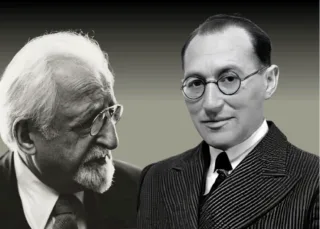



 Listen on Spotify
